

Project Management
Home
Project Management
Our Success Story & Our Working Principles
At TKare Engineering, we manage our projects through a lifecycle that ensures every step from the proposal stage to delivery is traceable, measurable, and compliant with quality standards. Leveraging our engineering expertise and advanced software infrastructure, we aim to complete your projects on time and with zero errors.
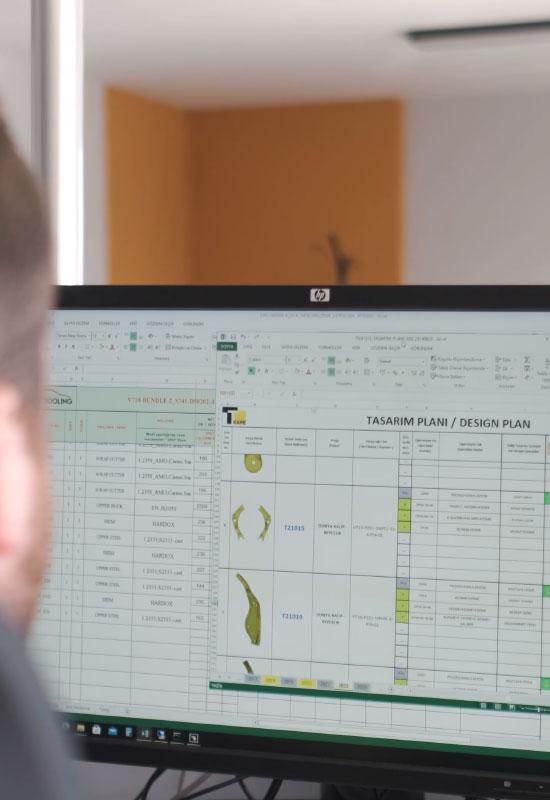
1. Process & Die Design Phase
This phase, which forms the foundation of the project, encompasses all technical feasibility, simulation, and design processes from the request for proposal through to customer approval.
- Customer & Data Acquisition: In accordance with customer requests, the project’s 3D and 2D CAD data is imported into the system, and technical requirements are analyzed.
- Feasibility Analysis: The most appropriate approach is determined by examining the product’s manufacturability, production volumes, and sheet metal utilization rates.
- Proposal Presentation &Approval: A technical and commercial proposal prepared based on the feasibility results is presented to the customer, and the approval process is completed.
- Simulation & Formability: Sheet metal formability simulations are conducted in a virtual environment to prevent potential defects (tearing, wrinkling, springback) while the design is still in progress.
- 3D Process & Die Design: A 3D process design compatible with the production methodology is developed, followed by detailed die designs.
- Customer Approval: The completed designs are presented to the customer to obtain final approval prior to manufacturing.
2. Die Manufacturing & Production Process
Following design approval, the material procurement and manufacturing steps during which digital data is transformed into a physical product are managed.
- Production Planning (Gantt Chart): Manufacturing steps are converted into detailed work plans and Gantt charts in accordance with delivery schedules.
- Material Procurement & Incoming Inspection: Certified raw materials and standard mold components that comply with the design specifications are procured; materials arriving at our facilities undergo incoming inspection processes.
- Precision Machining (CNC, Heat Treatment, Wire Cutting): Die components are machined on high-precision CNC machines, undergo heat treatment for strength, and are subjected to wire erosion/wire cutting processes to meet detailed tolerances.
- Assembly & Die Break-in (MAP): All machined die components are assembled, and the precision break in and fine tuning processes (MAP) are completed.
3. Initial Trial & Sample Setup (T1 / Trial)
This is the stage during which the first practical applications of the completed dies are carried out on-site and preparations are made for mass production.
- Press Trial (T1): The initial stamping trials of the die are carried out under the press in accordance with simulation data.
- Practical Applications & Improvement: Samples taken from the initial stampings are examined to make necessary fitting, form improvement, and practical adjustments on the die.
4. Measurement, Inspection & Delivery
This is the final inspection stage where the quality of the die is verified and the die is delivered to the customer.
- 3D Measurement & Reporting: Stamped parts (sheet metal products) produced from dies that have completed their practical applications are inspected using 3D scanning and measurement devices.
- Customer Approval & Shipping: Detailed measurement and quality reports are submitted to the customer. Following customer approval, the mold is securely packaged and shipped.

TKare Engineering; provides high-precision sheet metal die design, simulation, and engineering solutions for the automotive, aerospace, defense, and home appliance industries.